
Associate Professor of English Erin Pearson goes to the page, still blank. The thoughts just aren’t appearing until finally she remembers what her grandfather told her.
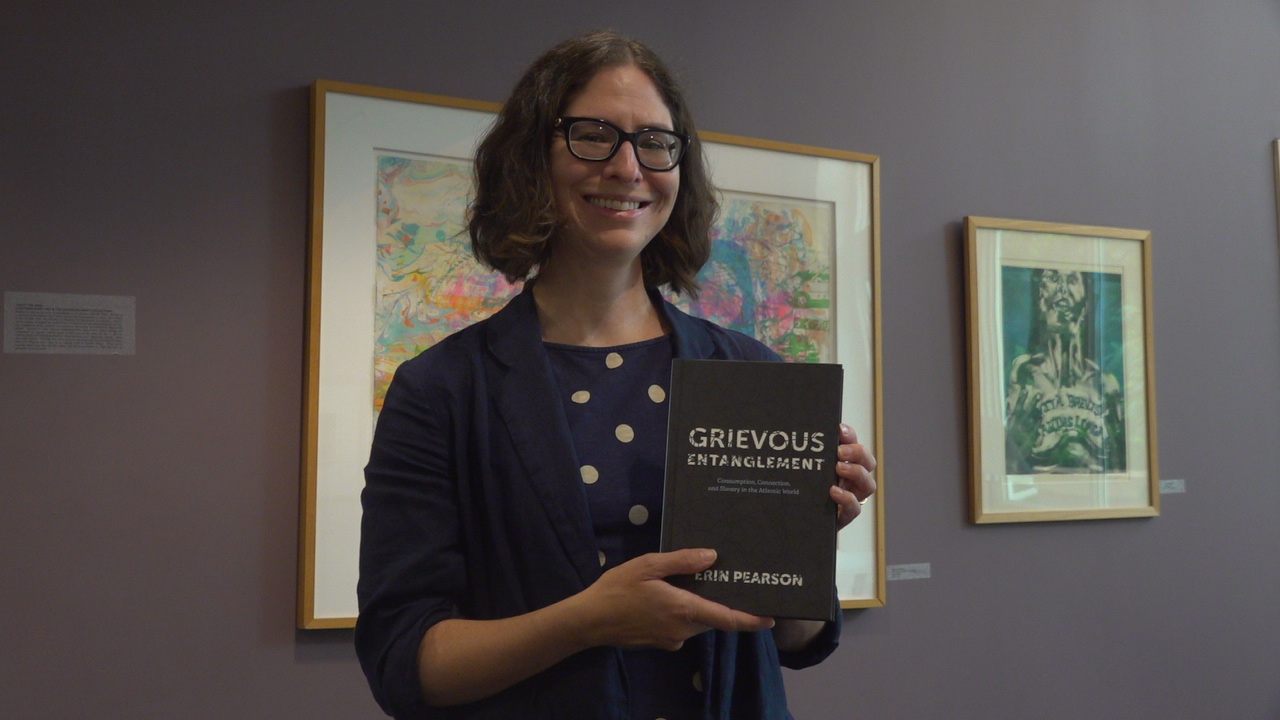
Pearson was awarded the 2026 Arthur Miller First Book Prize for her book “Grievous Entanglements: Consumption, Connection, and Slavery in the Atlantic World.”
The Arthur Miller First Book Prize is given by the British Association of American Studies to authors of books that showcase “originality and significance to the field” as well as “intellectual rigour.” The prize is named after Arthur Miller, an American storyteller who contributed to American Studies in the United Kingdom.
Pearson said she feels honored by the prize, and that it is meaningful to her to have the book recognized by a group of experts in the field.
“The fact that it’s a book prize from the British Association of American Studies also feels fitting, given that my book puts the United States within an Atlantic context,” Pearson said.
“Grievous Entanglements” was published on Oct. 21, 2025. The book dives into the abolitionist movement and into the dangers of consumption and complicity. It illustrates how being physically distant from slavery did not equate to being detached from the system that enforced it.
“What I would want people to take away from this book is recognizing that if you’re telling that story, you have to understand how central ideas about consumption work,” Pearson said, “They really structured the ways in which people talk and wrote and thought about their own connection to slavery.”
Consumption is the spending of goods to satisfy people’s immediate desires.
Pearson said her grandfather would talk about his life as a white man in segregated Alabama. He showed her what he learned about discrimination, and that encouraged her to study more. It took her 13 years to write “Grievous Entanglements.”
“I love digging into the tiny details of language or images,” Pearson said, “That is the greatest pleasure I get in studying anything. But as you might imagine, when you’re taking the time to sort of burrow into the small details, it means that it really can take a long time to read all the things you have to read.”
Pearson wrote her dissertation about the metaphor of cannibalism used in slavery and that got her interested in writing a book. Cannibalism was used to call enslaved African Americans cannibals and uncivilized. It was also used by abolitionists to compare slavery to cannibalism. Because the phrase kept coming up she wanted to research its meaning.
“You have Frederick Douglass describing slavery as sort of a monster that’s greedily devouring our flesh,” Pearson said. “You have Henry David Thoreau talking about slavery as being about the same as turning men into sausages.”
Pearson said she loves to read literature and used poetry and novels as sources in her book. She also looked at historic documents and even used photos in the book. She loved how the publisher was able to print them in color.
Pearson analyzed political cartoons, speeches, letters and journals that people wrote in the time period. She was excited to learn about Songsters, a pocket book of lyrics that people could sing.
She even used her research in the classroom. Her students read poetry from Elizabeth Margarete Chandler, a white American quaker who encouraged women to abstain from sugar in their tea times. Pearson followed one of Chandler’s recipes for honeycakes.
“My students hated them, they do not taste the way our modern palate expects sweet cakes to taste,” Pearson said.
Pearson said her book is applicable to today because aspects of slavery still influence parts of America and countries outside of it. Understanding language used around race and racism in the past reveals how it is relevant in the present, and strategies used to work against the system of slavery can be used to tackle modern problems such as systemic racism or climate change.
“The book also offers a kind of pre-history of familiar aspects of modern consumerism, such as fair trade coffee,” Pearson said.
Pearson’s advice to young writers is to find ways to move through projects at a consistent pace, despite what many believe about being a writer.
“I think many of us can fall into the trap of thinking that writing should follow a lightning bolt of inspiration and pour out of us as a perfect final product,” Pearson said. “In reality, at least in my experience, writing is a combination of inspiration and exciting ideas and also rolling up your sleeves and getting the ideas onto the paper in some imperfect form and then steadily improving them once they’re there.”
Pearson said that the process may sound monotonous, but it is what led her to move past the view of a blank page.

Lua Agbaw
Lua Agbaw is a rising senior at Sallie B. Howard School in Wilson, North Carolina, where she has been a part of her school’s student government association, National Honor Society and National Art Honor Society. She participates in many community-building and youth empowerment activities at the Triangle Bahá’í Institute. Lua is a member of her school’s high school choir, and she dances, draws and writes. Because of her interest in the arts, she plans to double major in music and strategic communications. She was drawn to communications through her love for learning about the world and telling stories. Some of Lua’s other interests include K-pop, fantasy books and superheroes.

Sara Anderton
Sara Anderton is a rising senior who goes to Fuquay Varina High School in North Carolina. She wants to go to college for journalism and has been her school newspaper’s news editor. Along with journalism, she loves writing and studying other languages, especially American Sign Language and Hebrew. Sara has been FVHS’s ASL club president since sophomore year. She has also self-published two books on Amazon. She is passionate about education and sharing her creativity, which reflects in all she does. Sara enjoys volunteering with Together On Center Stage, a theatre group for people with emotional and physical disabilities. She also enjoys volunteering with Breakthrough T1D, an organization working to find a cure for Type 1 diabetes. These organizations are close to her because she has a father with Type 1 diabetes and deaf and blind friends. Sara cares for people, and her passion for journalism will help her expose injustice and take care of others.