

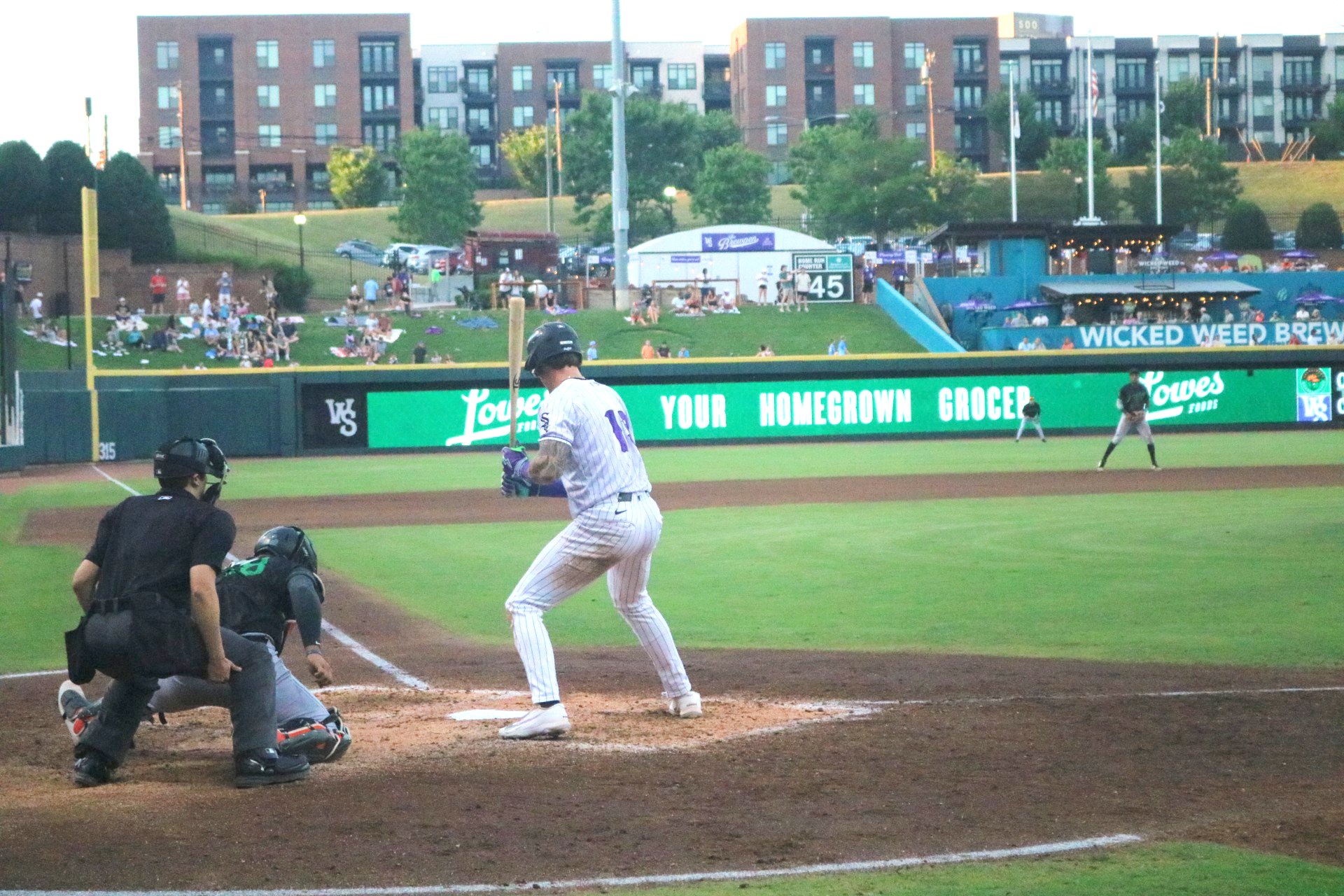
Every year minor league baseball teams spend tens of thousands of miles on the road and over 100 games on the field, all while making 20 times less than their major league counterparts.
Minor league baseball teams consistently play six games each week, with a season running from early spring to early fall. According to players with the Winston-Salem Dash, this schedule often defines the lives of the players who dedicate their time to the game.
Members of the Dash say this schedule tests not just the team, but also their families waiting at home. As a professional baseball player, athletes clock almost 1,500 hours at the stadium each year, equivalent to over two months on the field.
“I’d say 90% of the day you’re at the field and then once you get back home, you’re sleeping,” Dash shortstop Kyle Lodise said.
Lodise said professional baseball players experience physical, financial and mental strain from long days on the road and in the stadium. Families of these athletes face separation and monetary strain from the traveling and preparation it takes to make it into the major leagues.
“These sacrifices are, I would say, from my family members,” Lodise said. “The amount of time and money that they’ve invested just to give me the opportunity to be here.”
Ryan Burrowes, Dash shortstop, agrees that athletes make varying sacrifices to succeed in the league.
“Even though baseball is hard, it’s pretty much everything,” Burrowes said. “It’s mental. It’s not that much physically, but you have to be able to maintain that coldness of your mental state and just to be able to overcome adversities when you’re not doing good.”
The minor league and the Major League Baseball Players Association guarantee on-site mental health services, educational support and peer support while unionization allows minor league players to receive financial support from the league, and provides the option for players to sign name, image and likeness deals.
“I think they’ve also gotten a lot better with understanding that, with how much we kind of endure on a day-to-day basis that the mental side of it and just the resources in general are a lot more important,” Lodise said.
Name, image and likeness deals allow players across fields to receive extra funding through endorsements, social media branding and merch.
“You know, especially since COVID. I think that the major league baseball and MLBPA have done a good job of giving players a lot more resources,” Lodise said.
Team manager and former MLB player Guillermo Quiroz said Dash players have an intense passion for baseball that is shown in their attitude and consistency at tough practices.
“I mean, that’s your job,” Quiroz said. “That’s what you gotta do. Obviously impacts when it comes to, health, family, doing sacrifices for them to be able to be out here and do their jobs.”
Professional players train for the majority of their lives for the opportunity to play in the major leagues.
“I started playing at around 2 or 3 years old growing up,” Lodise said. “And that’s all I’ve ever known, just playing baseball.”
Members of the Dash affirm that the MLB is the overarching goal. In the past 17 years, the Dash have sent 361 players to the major leagues.
“They’re here to get developed, to go to the next level,” Quiroz said. “And then hopefully from there they can take off and play at the big league level.”

Anika Kurup
Anika Kurup is a rising senior at Chapel Hill High School in Chapel Hill, North Carolina. She is passionate about athletics, running year-round for her school, while playing basketball on the side. After initially creating YouTube videos for fun, she has grown more interested in film and media studies, and plans on studying the subject in college. As founder and president of her school’s Powerlifting Club, she is dedicated to teaching students about proper lifting techniques. She is also an active member of the Spanish National Honor Society, volunteering with elementary schoolers in her free time. Outside school, Anika likes to play piano, rock climb, and spend time with friends and family.

Blake Pierre-Louis
Blake Pierre-Louis is a rising senior at McQuaid Jesuit High School in Rochester, New York. Inspired by the story of Lonnie G. Johnson, a NASA engineer and inventor of the Super Soaker, Blake discovered his passion for journalism through advocacy storytelling by researching Johnson’s legacy and presenting it to third-grade students to highlight the often-overlooked contributions of Black innovators. That experience shaped his belief that great storytelling gives voice to stories that deserve to be heard, a conviction he brings to his interest in sports broadcasting, where he looks beyond the scoreboard to explore culture, identity and the human spirit. A performer at heart, Blake is a saxophonist in his school’s concert band and an active participant in theatre, and he plans to pursue an undergraduate degree in journalism with a focus on sports broadcasting, while enjoying skiing and spending time with his two dogs, Ruby and Oliver.

Amirah Williams
Amirah Williams is a rising senior in the Middle Creek High School Adobe Digital Media Academy, in Apex, North Carolina. She is deeply committed to inclusivity and visibility in the communication industry. She is the founder and president of the Middle Creek Black Student Union, as well as the founder of her school’s food pantry. She is the outreach officer for her academy, as well as the outreach officer for her local chapter of SkillsUSA, where she has competed at the state and national conference in video news production as a news anchor, placing fourth nationally. She competed this year for a student Emmy, writing a report and filming and editing a package on Anne Holt and inclusivity in industry. She has displayed her passion for communications through her work with The Durham Bulls broadcast team, WRAL and the North Carolina Coastal Pines Girls Scout council’s marketing office. She enjoys nature and hanging out with her friends, often hiking and paddleboarding.