

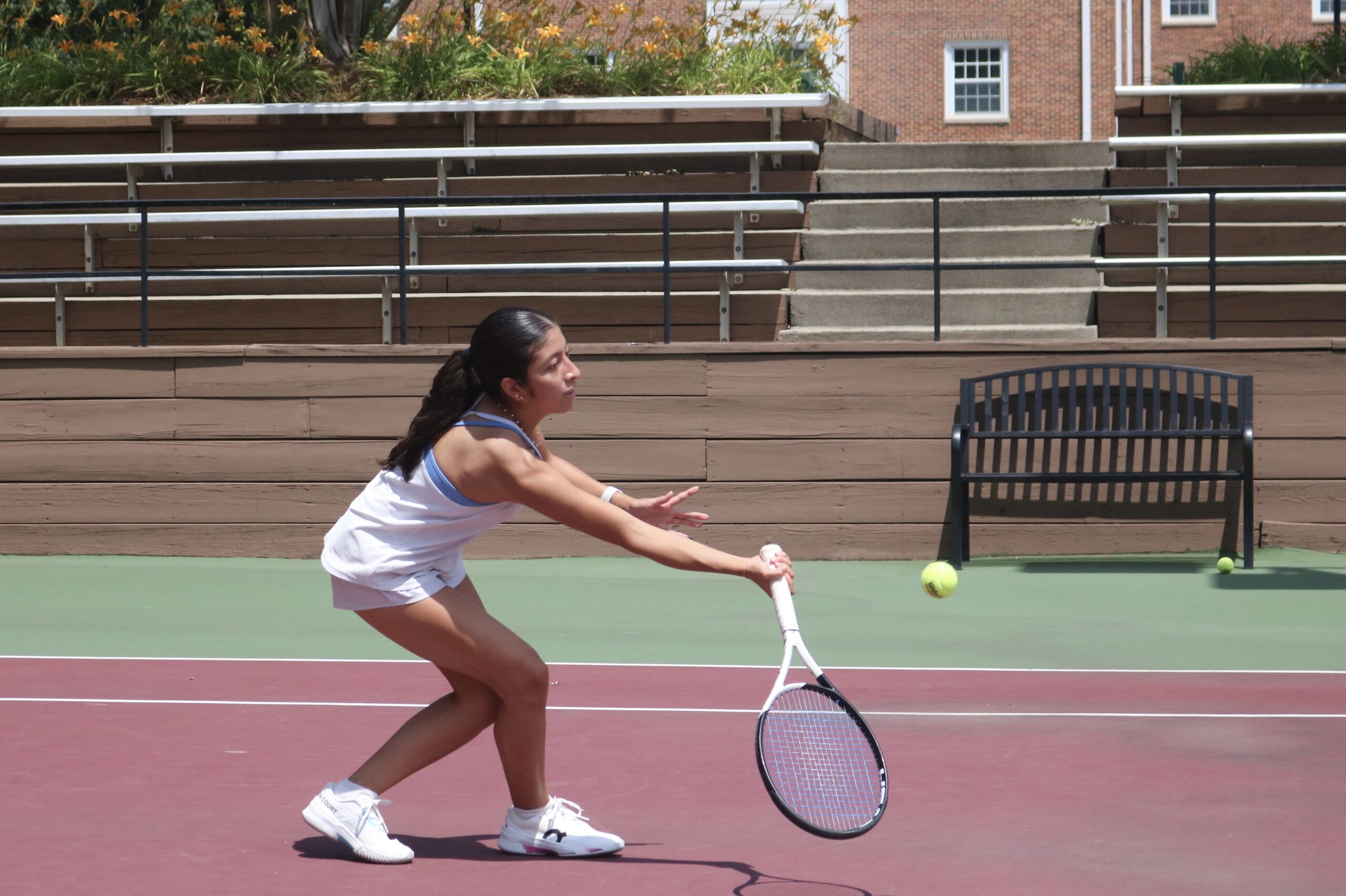
The Elon Tennis Academy combined intensive instruction with supportive coaching during a four-day camp designed to develop the skills of tennis players ages 5-18.
Having operated for the past 17 years, the tennis academy uses both high-intensity practice and fun activities to develop players and create an engaging atmosphere.
Elon women’s tennis head coach Elizabeth Anderson said the academy’s goal is to help each player improve according to their individual abilities and goals.
“We try to set up a very positive environment where players enjoy learning, they enjoy coming to camp and working hard and getting better,” Anderson said.
The camp’s daily structure reflected that balance. First, players complete technique-focused instruction, then apply those skills through activities such as games and head-to-head competitions.
Elon’s tennis academy was equally as challenging as it was supportive.
“We try to make it pretty structured to where there’s time for drills, there’s time for technique, but then there’s also time for more points and playing or fun tennis games,” Anderson said.
Anderson added that positive motivation still remains intense, as players often respond well when coaches communicate confidence in their abilities.
“I know you can do this, and I believe in you,” said Anderson, describing the message she tries to give athletes. “I know you can do better, and I want to help you to do better.”
Anderson said that coaches must recognize that players both learn and respond to instruction differently. So, instead of using the same method of coaching across athletes, she said coaches should take time to understand individual personalities, experience levels, and learning styles.
Anderson also said that long-term development depends on the internal desire to become better. Throughout the camp, coaches encouraged campers to stay engaged and work through challenging drills, but players must also be willing to push themselves if they want to improve.
“I think it’s that intrinsic motivation, that there’s something within them — there’s a fire, there’s a desire for them to be better than they are at that current moment,” Anderson said.
Elon Assistant Director of Athletic Communications Jacob Kisamore also identified this inherent drive as an important part of athletic development.
According to Youthcast Media Group, when high school students were asked why they quit sports, 45% said they left because the extremely competitive nature of the game began to outweigh enjoyment.
Furthermore, Kisamore said that youth sports programs should emphasize development along with competitive success without compromising on either goal.
“I think from the youth sports side of it maybe there’s not as much necessity in winning championships,” Kisamore said. “I think that side of it probably should be a little more like, ‘We’re going to develop you from a young age.’”
Additionally, the academy also gave Elon’s tennis program a chance to form and create relationships with young players and their families throughout the surrounding area.
“I think it’s a great opportunity for our team to give back a little bit to the local community and help build some connections with some kids and some families in the local Elon, Burlington, Alamance County area,” Kisamore said.

Caroline Cordon
Caroline Cordon is a rising senior at Alamance-Burlington Early College in Burlington, North Carolina. An avid reader, she is the president of the school’s book club and an active member of NHS, UNICEF, AsOne Bible club and Culture Collab club. She has been a student government representative for two years, organizing events and being a spokesperson for her classmates. Outside school, she immensely enjoys athletics and has played volleyball and basketball for her district high school. On a more competitive level, she’s participated in three years of travel volleyball. One of Caroline’s favorite pastimes is writing, and she won first place in a local writing contest in the fiction category. When she’s not reading, writing or playing volleyball, Caroline enjoys spending time with her family and friends, tutoring elementary schoolers in literature, and volunteering with her church’s youth program. She loves traveling and hopes to study abroad one day while pursuing degrees in psychology and English. Caroline is most passionate about learning new things, while also sharing her experiences with others.

Akshay Sudhakar
Akshay Sudhakar is a rising senior at McLean High School in McLean, Virginia. He is deeply interested in aerospace, mechanical and civil engineering. Akshay has explored these interests through programs such as the Virginia Aerospace Science and Technology Scholars program and the Harvard University Venture Tech Summer Program, while also competing in the KidWind Solar Challenge, where he placed first at the regional level and second at the state level. In addition to STEM, he has been actively involved in journalism and student media as a member of Quill and Scroll, a former anchor and director for WMHS News, and an attendee of the 2024 National High School Journalism Convention in Philadelphia. He has also run indoor and outdoor track for three years. Outside school, he is involved in youth leadership and community service through organizations such as the Kaveri Kannada Association, Chinmaya Mission CMWRC, Vedic Health and the National Education Association. Through these experiences, Akshay has developed a strong interest in both technical innovation and community-centered leadership. Beyond academics, Akshay enjoys traveling outside his hometown, playing soccer and watching his favorite soccer team, Manchester United.

Laszlo Dworkin
Laszlo Dworkin is a rising senior at Chaminade College Preparatory in Los Angeles. He thoroughly enjoys writing and engaging in deep conversation with peers on current world developments. He is immersed in Chaminade’s film program, entering the school’s highest level, Film 7, next year. He’s also the director of on-air talent for his school’s sports broadcasting program, where he offers color commentary on high school football games during the fall semester. He is obsessed with discussing everything sports, playing varsity tennis for Chaminade and being an avid NFL fan. Laszlo likes to hang out with friends on weekends and loves to sleep in whenever possible. Inclusivity stands at the forefront of his beliefs, as he strives to make outstanding impressions on everyone he meets.