

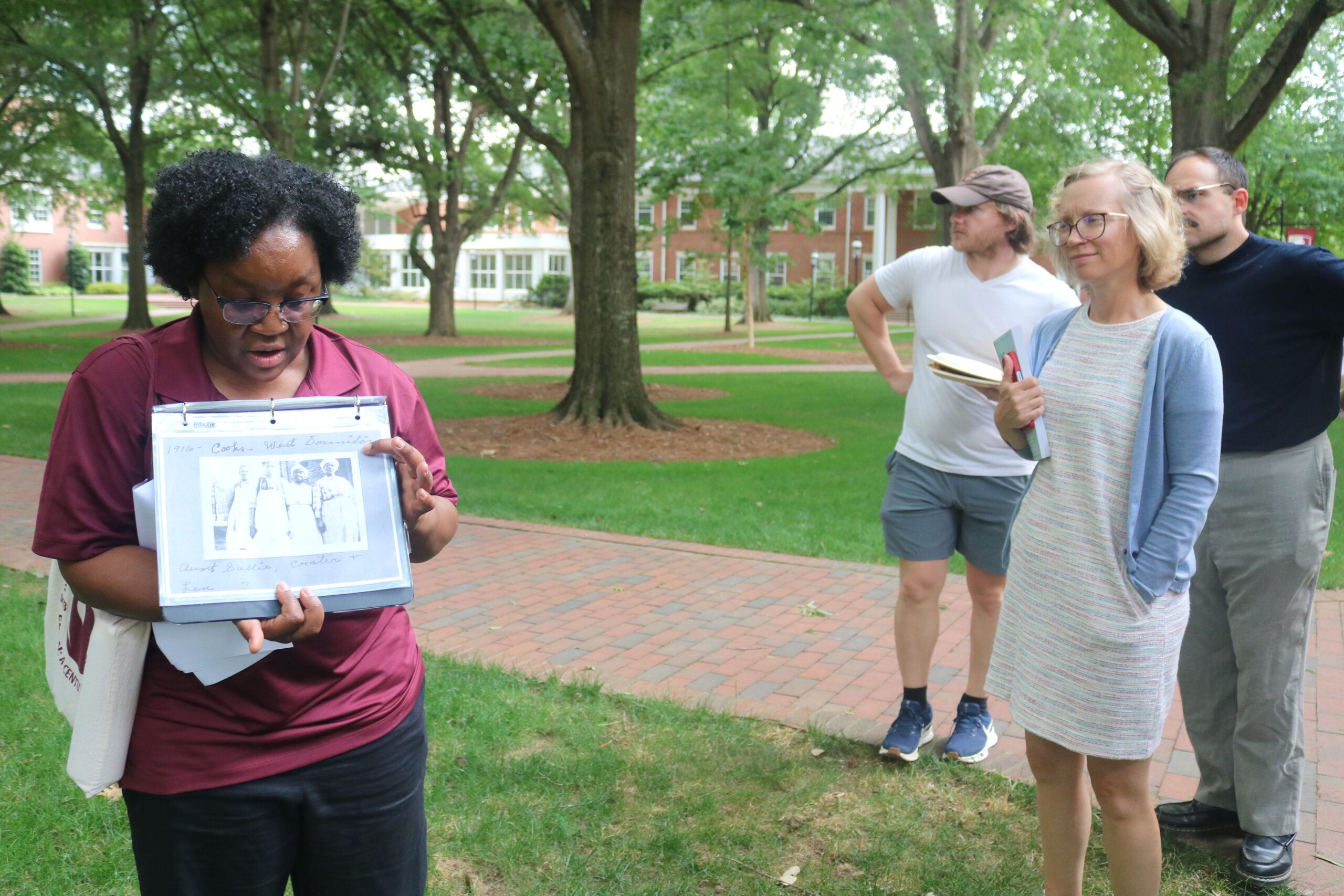
At Elon University, Juneteenth commemorations included a guided Freedom Footprints tour that showcased Elon’s Black history from its first Black students to notable Black staff and faculty of the school. Elon’s recognition of Juneteenth extended beyond a tour, as the month is dedicated to multiple experiences for the Elon community.
Shaunta Alvarez serves as Elon’s interim coordinator of University Archives and for the last few years has planned and led Elon’s Freedom Footprints tour to commemorate the holiday. Alongside her is Carla Fullwood, who is Elon’s director of inclusive excellence education and development. The two of them work side by side to provide what they hope to is a knowledgeable yet fun Juneteenth experience for students, faculty and staff.
Juneteenth became federally recognized in 2021 to remember the Emancipation of the last slaves in Galveston, Texas.
“To this day, a lot of people don’t make that connection, don’t fully recognize it.” Fullwood said. “And so to actually have events on campus, commemorating and honoring Juneteenth, is just one of the ways that we try to raise awareness and help support and continue to help … support knowledge of what this holiday means for our community.”
Since then events and community gatherings have taken place across the country and in the town of Elon it has been no different. During this year’s annual Freedom Footprints tour, participants were immersed into culture and history through visiting and seeing historical buildings, artwork and photographs all a part of Elon’s own history.
The tour kicked off inside of the Moseley Center which houses portraits of Elon’s first Black students, Glenda Phillips Hightower and Eugene Perry, featuring the struggles of attending a predominantly white university in the early 1960s. Alvarez continued through the tour taking participants to familiar sites on campus that are home to important Black history that has shaped the school. The sites included Alumni Gym, the Belk Library, Elon’s Historic Neighborhood and West Hall.
Through educational Juneteenth events such as Freedom Footprints, Alvarez said she hopes to show that “the history of Black people at Elon did not begin when students integrated. Or when the first Black students came to school here, Black people have been a part of this community from its founding.”
Fullwood said Elon employees were instrumental to the success of the commemoration.
“We had, about over 80 faculty and staff engage in lots of conversations around race, racial understanding, and understanding racial iniquity on our campus,” Fullwood said. “It was a really powerful moment that brought us together.”
Although Juneteenth lasts one Friday in June, Elon University officials said they hope to reflect on why the holiday is important to its story.
“I want people to come in and dig, and ask questions, and research,” said Alvarez because that’s how we learn. We’re not a museum where things are hands off. We want people to look at the yearbooks, we want people to touch the documents and handle the photos and ask questions. So they can learn about the history themselves.”

Olivia Nelson
Olivia Nelson is a rising senior at Heathwood Hall Episcopal School in Columbia, South Carolina. For the past three years, she’s worked diligently on The Highlander, Heathwood’s yearbook, and will be stepping into the role as editor this upcoming school year. Aside from her yearbook responsibilities, Olivia has represented her class on Heathwood’s class council and serves as a PEAK (Pursuit for Environmental Adventure and Knowledge) Student Leader, assisting with ropes courses and pond activities. She is also an active participant in Heathwood’s Youth In Government delegation, showcasing her talents as both an appeals attorney and legislator, and is now soon to be a clerk. Outside school, Olivia is a public servant to her community and has over 200 hours of community service with Meals On Wheels, Harvest Hope, Power In Changing and more. Most recently, she co-founded Loads of Love to help address the need for laundry supplies for the homeless in Columbia. In March 2025, Olivia embarked on a trip to Kenya for a community engagement project with her school, where she helped repair a primary school and donated to the Voi community. She is also an active member of the Columbia chapter of Jack and Jill, where she has served as secretary and now as legislative chair. Aside from her extracurricular activities, Olivia enjoys traveling to new places, both in and outside the country, and has visited four of the seven continents. Fashion has always been a huge passion of Olivia’s, as she loves curating and shopping for unique pieces to add to her wardrobe.

Kadin Crawford
Kadin A. Crawford is a Greensboro Day School student in the class of 2027, who is passionate about writing, global affairs, film and storytelling. He’s been involved in Model United Nations since ninth grade and completed a Georgetown University course to strengthen his research, diplomacy and public speaking skills. Kadin plays golf and has played piano and trombone since fifth grade. He’s also served twice as a student council representative, gaining experience in leadership and teamwork.