

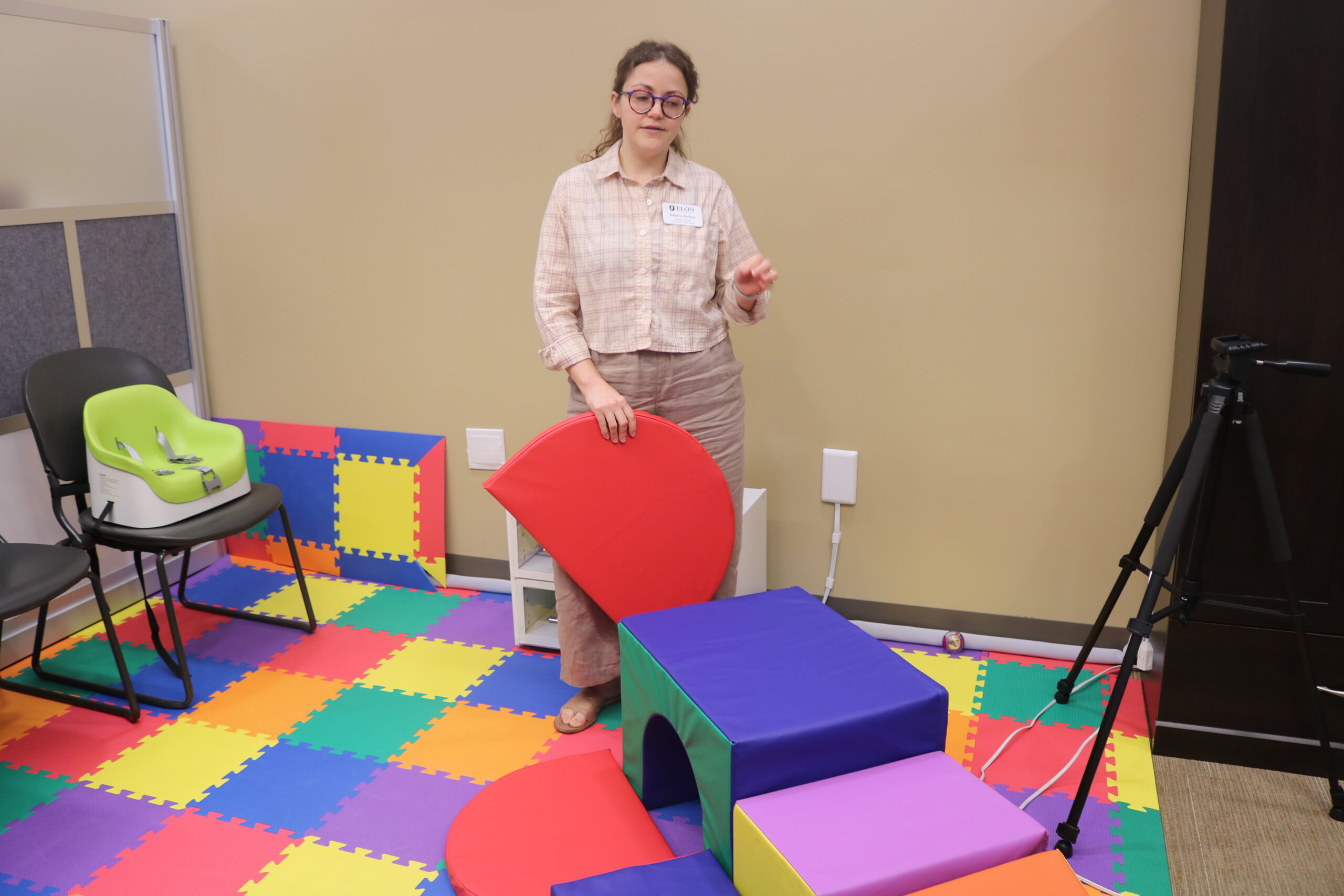
Human brains constantly take in, process, and apply ideas, even in infancy. But, according to Sabrina Perkins, associate professor of psychology at Elon University, infant research is uniquely difficult.
Working with children under the age of 2 introduces the tediousness of direct communication, increased privacy, and extended breaks. All of which leads to the lack of available infant studies to draw research from.
Sabrina Perkins worked to bridge that gap by conducting studies in her own office. Perkins looked at the development of hand dominance within infants to conduct research.
“I was drawn to movement specifically because, like other animals, infants can’t tell you what they’re planning or how they feel — but you can observe all of that through their activity and movement,” Perkins said.
Perkins has been assisted by undergraduate students of varying majors, diffusing infant development into their own fields.
Senior exercise science major Jessica Garcia-Bastida looked into the applications of infant development within physical therapy.
“This research could help set a baseline, so that if a child isn’t meeting a certain milestone, we can look into why,” Garcia-Bastida said.
On the other hand, senior psychology major Anna Grace Gilbert applied her findings to the field of psychology.
Gilbert and her team noticed that when babies reached for a toy, their mothers were more likely to name and explain that object. Psychologists call this phenomenon “joint attention,” which is a fundamental building block in how babies learn.
Being a psychology major, Gilbert was surprised by the implications of infant development throughout professional fields.
“I presented a poster on this research, and I learned how expansive the field of development really is,” Gilbert said.
She explained that understanding how humans learn helps roboticists understand how robots learn, furthering the efficiency of building AI models.
Perkins, Garcia-Bastida, and Gilbert all mentioned the importance of role-differentiated bimanual movement (RDBM) in the development of an infant.
RDBM is the process of performing separate tasks with each hand while having a common shared goal. For example, if an infant is handed a water bottle, they will hold the bottle with one hand while twisting the cap with the other.
The group linked RDBM with development, as it signals growth in the portion of the brain that connects the two hemispheres.
“I teach my students how motor development affects cognitive skills and vice versa, and how it connects to social-emotional development and varies across cultures,” Perkins said.
Perkins and her team continue to work toward closing that gap. Her infant development lab at Elon remains active, with multiple ongoing studies currently underway.

Anika Kurup
Anika Kurup is a rising senior at Chapel Hill High School in Chapel Hill, North Carolina. She is passionate about athletics, running year-round for her school, while playing basketball on the side. After initially creating YouTube videos for fun, she has grown more interested in film and media studies, and plans on studying the subject in college. As founder and president of her school’s Powerlifting Club, she is dedicated to teaching students about proper lifting techniques. She is also an active member of the Spanish National Honor Society, volunteering with elementary schoolers in her free time. Outside school, Anika likes to play piano, rock climb, and spend time with friends and family.

Thailik McCormick
Thailik McCormick is a rising senior from Central Carolina Academy in Sanford, North Carolina. Thailik found a love for public speaking at DECA and furthered that love when becoming a founding member of his school’s new segment. When not directing the episode for the week, he always ran a special segment with a friend, interviewing students, teachers and staff members. Afterward, he became a Teen Court defense and prosecution attorney, expanding his public speaking skills, all while finding a love for law. Being awarded Quesbridge Scholar Prep, Thailik hopes to go to college for journalism and political science.