

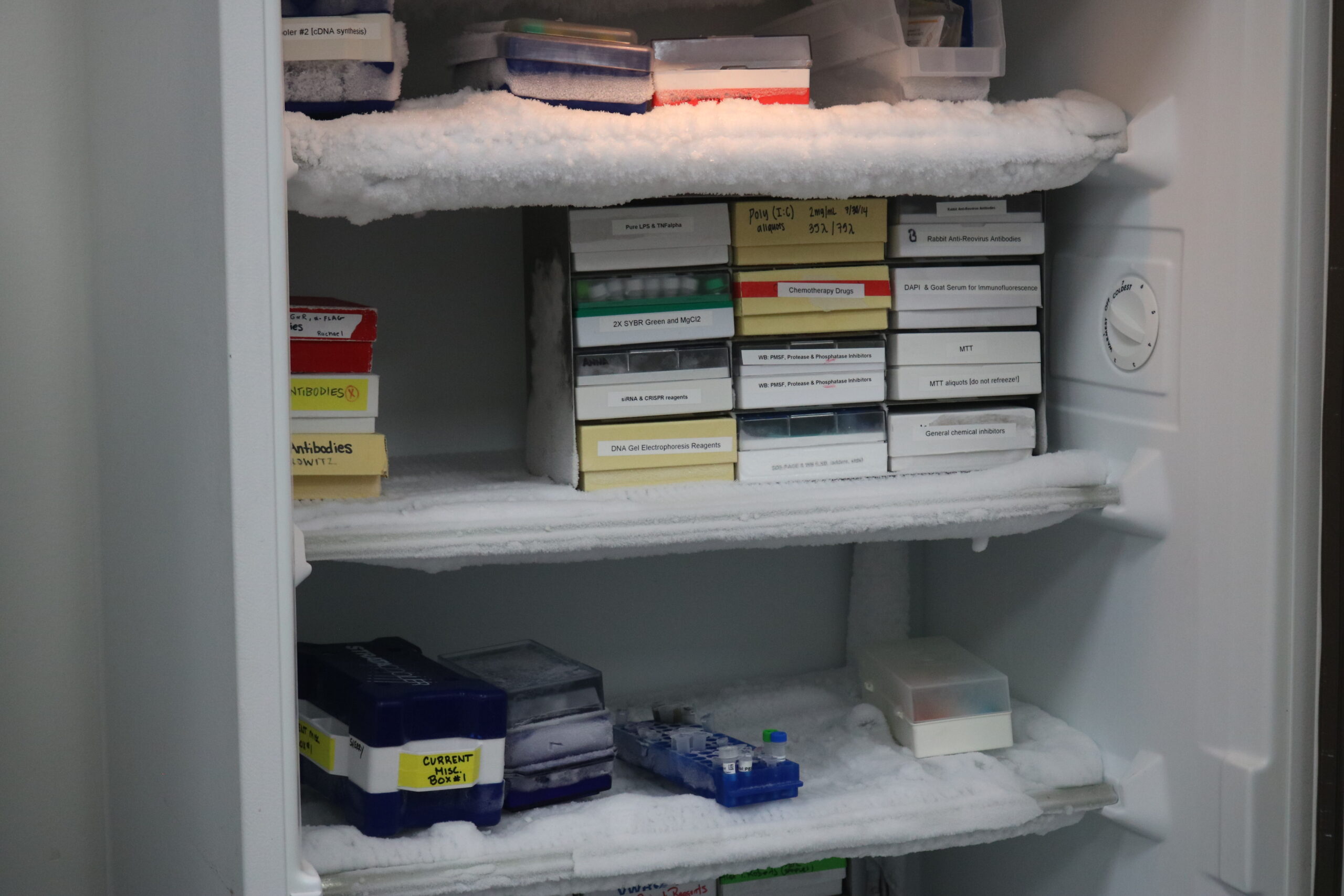
Viruses may not be the evil antagonists they are often thought to be. In fact, viruses may be the next step in cancer research.
Oncolytic therapy uses viruses to destroy cancer cells. According to Alexander Roberts, a rising senior at Elon University, oncolytic therapy holds great promise for changing cancer research, although it remains under-researched.
“I’ve always loved science, especially in high school — that’s kind of where my science focus started,” Roberts said. “Getting to use my hands, getting to do work, is something I really like. I took four science courses in high school, and of all of them, I liked the life-science-focused ones the best.”
He has been working under the guidance of assistant professor of biology Efrain Rivera-Serrano to use reovirus as a new oncolytic treatment for fibrosarcoma, a rare, understudied cancer affecting muscles, bones, and soft tissue. It is difficult to treat because of its capability to spread quickly through the body, primarily via bones, soft tissue, muscles, and lungs. Currently, fibrosarcoma has about a 40-60% survival rate.
Oncolytic treatment uses genetically modified or naturally occurring viruses to destroy cancer cells while sparing healthy tissue, and it’s used to supplement chemotherapy. Targeting creates the main difference between these two types of treatment: Chemotherapy aims to destroy all cells, which is why cancer patients lose hair and gut health, while oncolytic treatments hit cancer cells specifically, via injection directly into the cancerous tumor or region. Both treatments work in their own ways, and Roberts said both oncolytic treatments and chemotherapy can be used together to maximize the effects of the treatments.
Roberts said while researchers can use naturally occurring viruses, oncolytic treatment works best when they design viruses with distinct attributes, otherwise known as genetic modification. But, genetic modification of virus cells is a shortcoming of this treatment.
Even if reovirus can target specific pathways, the immune system relies on many different signaling and defense mechanisms. As a result, other immune system responses can affect how the virus spreads, as well as how the body reacts. Alongside that, this treatment lacks a perfect success rate. During the period of treatment, the virus can behave differently or possibly deteriorate over time.
Roberts said he tested two different strains of viruses, DB62 and EW46, to identify which was more effective.
“DB62 is great at infectivity — it gets into cancer cells and kills them very effectively,” Roberts said. “For the most part, though, results have matched expectations — DB62 kills well, EW46 infects well but kills less.”
The issue with most modern cancer treatments is the worry of cost and while Roberts said there isn’t an exact number for the cost, he indicated that the cost is not substantial.
“I don’t think it would cost a ton,” Roberts said. “From studies on the enhanced virus that’s currently in clinical trials, it’s not super hard to do. Once you know which virus genes target the immune factors in cells, you know how much to edit them up or down. The genetic editing part isn’t too complicated.”

Blake Pierre-Louis
Blake Pierre-Louis is a rising senior at McQuaid Jesuit High School in Rochester, New York. Inspired by the story of Lonnie G. Johnson, a NASA engineer and inventor of the Super Soaker, Blake discovered his passion for journalism through advocacy storytelling by researching Johnson’s legacy and presenting it to third-grade students to highlight the often-overlooked contributions of Black innovators. That experience shaped his belief that great storytelling gives voice to stories that deserve to be heard, a conviction he brings to his interest in sports broadcasting, where he looks beyond the scoreboard to explore culture, identity and the human spirit. A performer at heart, Blake is a saxophonist in his school’s concert band and an active participant in theatre, and he plans to pursue an undergraduate degree in journalism with a focus on sports broadcasting, while enjoying skiing and spending time with his two dogs, Ruby and Oliver.

Thailik McCormick
Thailik McCormick is a rising senior from Central Carolina Academy in Sanford, North Carolina. Thailik found a love for public speaking at DECA and furthered that love when becoming a founding member of his school’s new segment. When not directing the episode for the week, he always ran a special segment with a friend, interviewing students, teachers and staff members. Afterward, he became a Teen Court defense and prosecution attorney, expanding his public speaking skills, all while finding a love for law. Being awarded Quesbridge Scholar Prep, Thailik hopes to go to college for journalism and political science.

Yashika Jagadeesh
Yashika Jagadeesh is a rising senior at Triangle Math and Science Academy and a passionate advocate for student voice, leadership and public health. She currently serves as vice president of student government and will step into the role of president next year, while remaining actively involved in HOSA, DECA and Dance Club. As a dedicated leader beyond the classroom, Yashika serves as a robotics coach, has contributed over 100 volunteer hours and volunteers as an SAT coach, helping students strengthen their academic skills. Deeply committed to health advocacy, Yashika is an active member of the Wake County Youth Health Council and the NC T21 Coalition, where she works to address teen health issues, particularly youth vaping. Her passion has translated into competitive success, earning her third place in Health Education at the HOSA International Leadership Conference and qualifying for international-level competition five times across both HOSA and DECA. In athletics, Yashika is a year-round athlete, serving as captain of her cross country team and a three-time MVP, while also competing in track. In addition, she pursues classical Bharatanatyam dance, having successfully completed her Arangetram, a milestone performance representing years of rigorous training and cultural dedication. Across all her pursuits, Yashika is driven by a commitment to empower others, build inclusive communities and stay true to herself.