

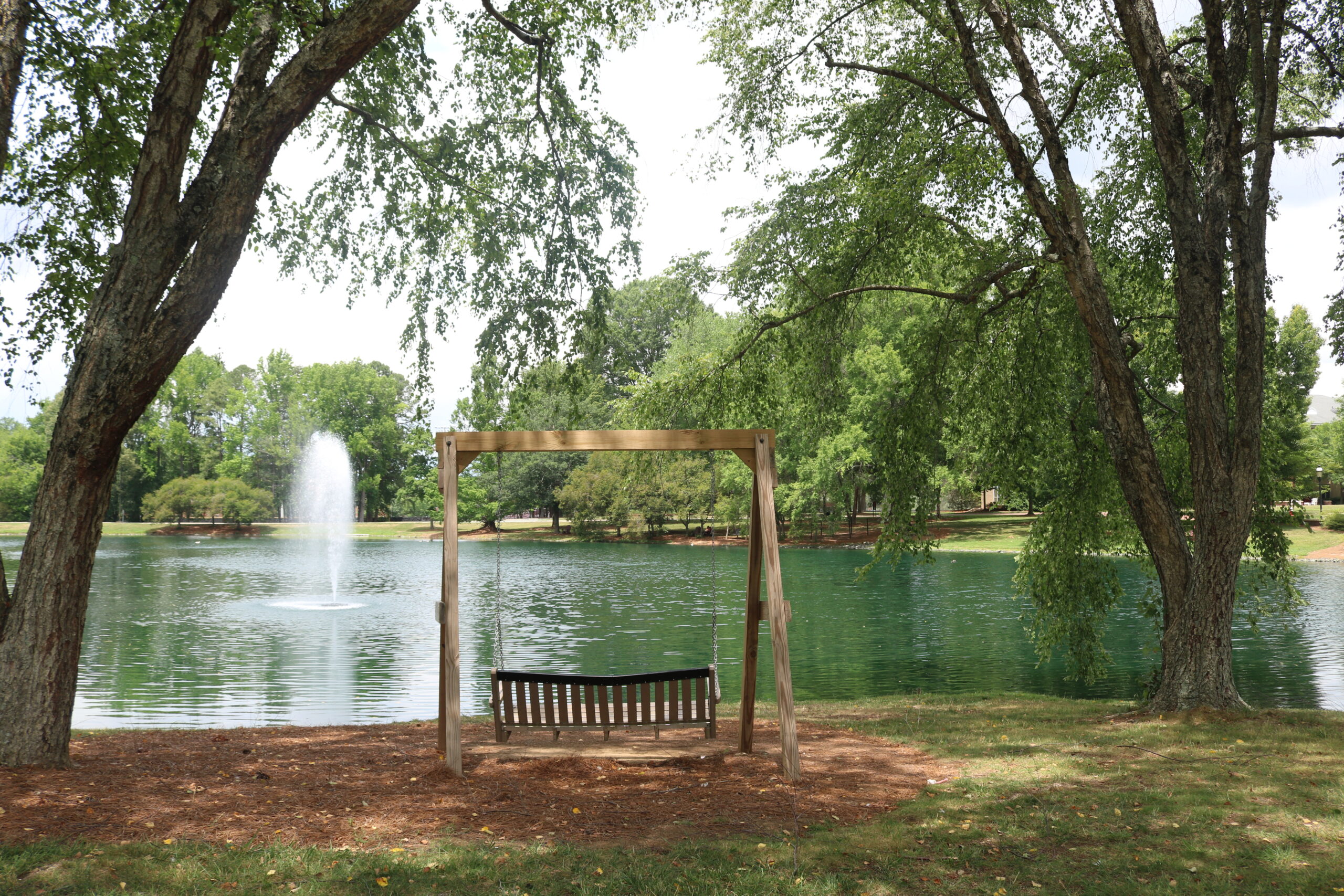
Elon University faculty and students have published research focused on nature-based mindfulness and its effect on undergraduate students’ mental health. The study is characterized by “sit spots,” commonly near water or peaceful areas closest to nature that help people concentrate on their emotional well-being.
Jill McSweeney, assistant professor of wellness, and Kelsey Bitting, assistant professor of environmental studies, coauthored the study “Evaluating the Impact of a Sit Spot Mindfulness Practice on Students’ Connectedness to Nature, Mental Wellbeing, and Mindfulness.” Together, they described the importance of “sit spots,” to help college students stay connected to nature and prioritize their mental health, focusing on sensory details.
McSweeney explained the purpose of the study was to see how nature helps to engage in mindful practices, while also improving mental health.
“So we know that from our work, that it increases positive mood. So, a feeling of joy and happiness while also decreasing negativity,” McSweeney said.
Along with McSweeney and Bitting, alumnae Elyssa Kaufman and Kira Campagna played key roles in the study. Their research showed an increase in positivity, nature connectedness, and mindfulness displayed in respondents.
Kiley Sherlock, a student at Elon University who is pursuing a double major in environmental and sustainability studies and public policy, described nature-based mindfulness as associated with intention and living in the moment. This consciousness is effective for students dealing with feeling overwhelmed and stressed.
“We’re trying to investigate what that looks like when you’re practicing mindfulness outside and whether you’re getting the same benefits we associate with nature and mindfulness separately,” Sherlock said.
To assess if the study was beneficial, students participated in numerous surveys, which measured positive and negative effects and mindfulness. Students who completed eight or more “sit spots” experienced significant improvements within their well-being, including mood, nature connectedness and mindfulness.
As for students who completed less than eight “sit spots,” they experienced less positive change, missing out on deeper nature connectedness.
Sherlock explained an interesting aspect of the study is that it acts as a bridge between mindfulness and nature.
“What we’re really seeking to address is the mental health crisis in the classroom, specifically for college students,” Sherlock said.
Bitting explained the novelty of the study as being an intersection between two commonly investigated topics.
“That is not something that has been done to a great degree in the literature we’ve found so far, so it’s pretty unique in that respect,” Bitting said.
Around Elon University there are many “sit spots,” including Lake Mary Nell and Lake Verona, that help students enter nature-based mindfulness. Sherlock explained her favorites are near water. Similarly, Bitting’s preferred location is a pond near her house, where she can watch the wildlife.
Sherlock and Bitting explained that struggles can be overcome by nature-based mindfulness, and previous research done at Elon University has proven positive outcomes, such as reduction in stress and anxiety, while improving mood and relationships.
But Sherlock and Bitting have heard some criticisms about the study, such as it being a waste of time and unproductive.
“Just because I’m sitting outside doesn’t mean I’m wasting time,” Sherlock said. “This research teaches you that taking a moment for yourself can be productive and a form of self-care.”
“So maybe,” Bitting said, “that’s something we’re trying to counteract: helping individuals recognize that they’re part of this earth system, not separate from it or above it in some way.”
The nature-based mindfulness study was intended to give students an outlet where they could relieve themselves from daily stressors, while deeply connecting with nature.

Harriett Stell
Harriett Stell is a rising senior at Washington Montessori Public Charter School in Washington, North Carolina. She is an active member of her school’s National Honor Society, where she hopes to become president next year. Through the National Honor Society, she volunteers by tutoring at a local elementary school and supporting organizations such as Packs for Patriots and the Ronald McDonald House. Harriett is committed to serving her local community with passion and dedication. In school, Harriett has always had a love for writing, which has led to her interest in journalism. Throughout her years in high school, she has also held many leadership roles, including serving as a member of the Communication Arts elective, where she had the opportunity to photograph events and promote her school, and working as an editor for her school’s yearbook. For fun, Harriett enjoys a variety of hobbies, including playing on her high school’s varsity volleyball team, baking for her friends and family, scrapbooking, and watching movies.

Chloe Randall
Chloe Randall is a rising senior at Seaforth High School in Pittsboro, North Carolina. She has a heart for supporting the most vulnerable, especially individuals living with mental and physical disabilities, and is actively involved in Unified Club and Special Olympics. Chloe is the two-term president of her school’s Guitar Club and the co-founder of a student book club. She is an active member of the International Thespian Society, serving as stage manager and sound lead for school productions, and is also a member of both the National Honor Society and the English Honor Society. Her love of writing began at a young age, and her first published novel, “The Grumpy Platypus,” made its debut when Chloe was in fourth grade. Chloe also welcomes new students and visitors to her school as a Seaforth Student Ambassador. In her spare time, Chloe enjoys attending live concerts, reading, and spending time with friends and her cat, Yogurt.