

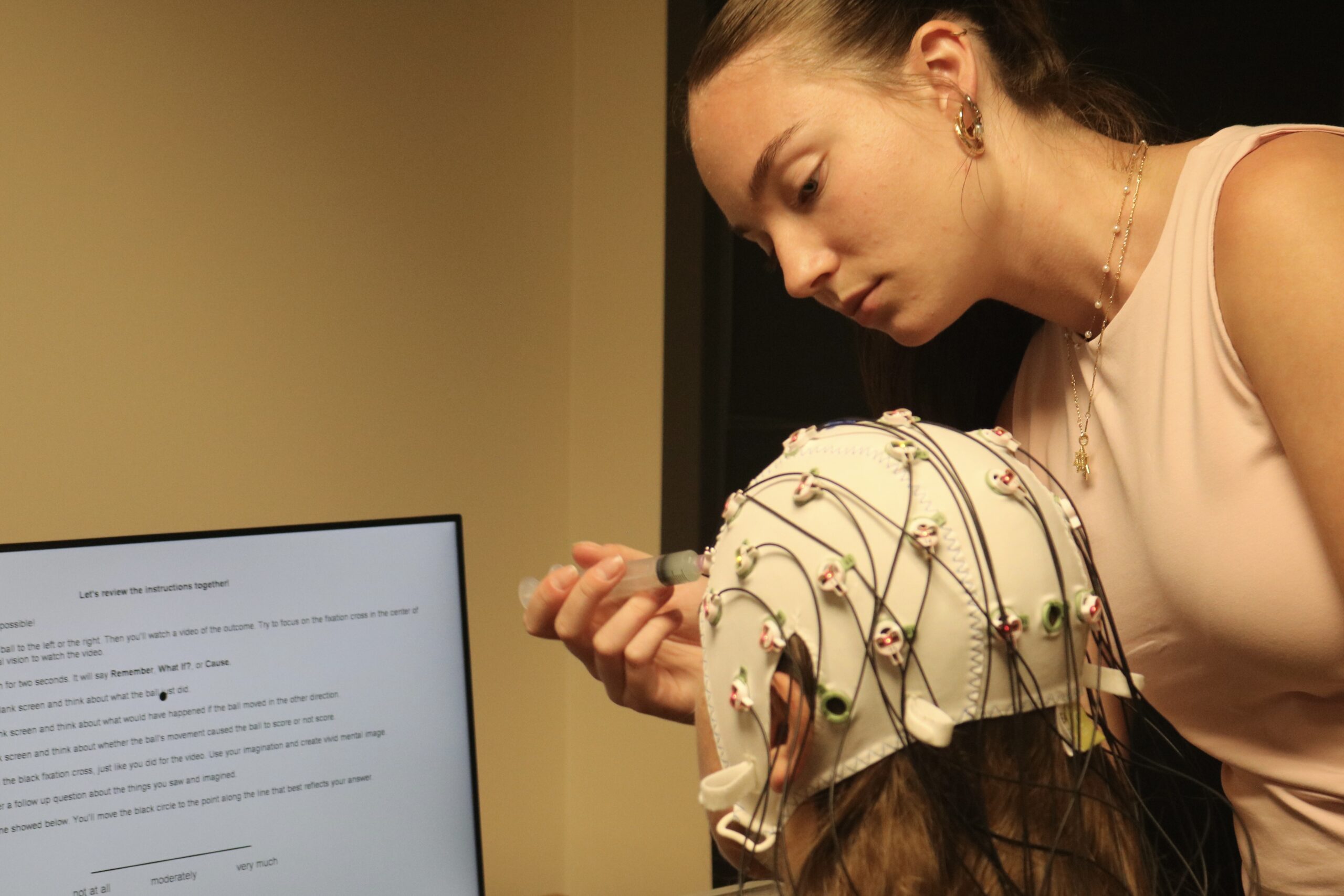
Elon University psychology students are using electroencephalogram (EEG) technology to study brain activity during decision-making to explain why people interpret the same event in different ways.
Humans constantly recall memories and events from previous experiences while considering why an event happened. But, the way individuals recall memories differs from person to person. Some rely on memories of what happened, while others imagine alternative outcomes. Senior undergraduate research student and psychology major Casey Baldwin’s recent study has the potential to help people understand why individuals interpret the same event differently.
Baldwin’s study, “Tracking EEG Neural Activity During Retrospective Causal Judgement,” was overseen by assistant professor of psychology Kristina Krasich. The two worked together to focus on retrospective causal judgment, or the process of looking back at an event and deciding what caused its outcome. This investigation studied how people used memories of what actually happened and imagined alternatives when making retrospective causal judgments.
Baldwin had been working on her most recent EEG project in Krasich’s laboratory for about a year. Krasich’s focus was to let her students take the lead role while providing support.
“I try to engage them in every stage of the research process,” Krasich said. “We begin typically by conceptualizing a project together, reading the literature, thinking through the logic, trying to really come up with a strong research question, a strong hypothesis. And then from there, it’s really just a collaboration together.”
To collect data, participants wore a 32-electrode EEG cap that recorded electrical data from the brain while they completed a computer-based stimulus task. During the experiment, participants chose whether to shoot a ball left or right before watching the outcome of their decision. The program then prompted participants to think about why the shot missed or alternative plays that could have occurred.
As participants completed the task, the EEG system recorded brain activity. Baldwin planned to use these neural signals to better understand how people acknowledged cause-and-effect relationships and personality changes.
“We’re looking at personality and how different personality types affect how people think – whether they rely on more memory or they rely on more mental images,” Baldwin said.
The study specifically examined the openness and agreeableness components of personalities. Baldwin and Krasich investigated whether these personality traits related to how strongly people relied on factual memories or imagined alternatives when judging why an event occurred.
Because data collection is still underway, the researchers had not yet determined whether those traits influenced the participants’ reasoning.
This act of imagining an alternative outcome was known as counterfactual thinking, or asking, “what if?” Additionally, people used causal judgments to understand choices, mistakes, responsibility and blame. These processes might have affected how people interpreted past choices, assigned responsibility, and decided whether a different action could have changed the result.
The EEG project was built on Krasich’s earlier research using eye-tracking technology. The use of eye tracking in past studies has aided researchers in understanding what subjects were thinking in correlation to a specific stimulus.
A previous study that used eye tracking and contributed to Baldwin’s research was an analysis comparing memories to imagination in cause-and-effect relationships.
The past investigation posed questions that were relevant to the current study and demonstrated academic ideas for Baldwin to focus on in her EEG study.
“To what extent do we just use our actual memories,” Krasich said, “versus how much do we use our imagination about what could have happened in any given different scenario, in order to determine a true, ‘This was the cause of this effect.’”
Krasich’s earlier eye-tracking study raised new questions about neural activity behind memory and thinking, which Baldwin’s EEG research study was designed to investigate.
Data collection is still ongoing, and no conclusions have been reached, but Baldwin believed the research could contribute to a broader understanding of human reasoning and decision-making. For Krasich, this research represents the larger picture of how the brain functions and makes sense of the world.
“Our primary objective is to advance basic scientific understanding,” Krasich said.

Akshay Sudhakar
Akshay Sudhakar is a rising senior at McLean High School in McLean, Virginia. He is deeply interested in aerospace, mechanical and civil engineering. Akshay has explored these interests through programs such as the Virginia Aerospace Science and Technology Scholars program and the Harvard University Venture Tech Summer Program, while also competing in the KidWind Solar Challenge, where he placed first at the regional level and second at the state level. In addition to STEM, he has been actively involved in journalism and student media as a member of Quill and Scroll, a former anchor and director for WMHS News, and an attendee of the 2024 National High School Journalism Convention in Philadelphia. He has also run indoor and outdoor track for three years. Outside school, he is involved in youth leadership and community service through organizations such as the Kaveri Kannada Association, Chinmaya Mission CMWRC, Vedic Health and the National Education Association. Through these experiences, Akshay has developed a strong interest in both technical innovation and community-centered leadership. Beyond academics, Akshay enjoys traveling outside his hometown, playing soccer and watching his favorite soccer team, Manchester United.

Caroline Cordon
Caroline Cordon is a rising senior at Alamance-Burlington Early College in Burlington, North Carolina. An avid reader, she is the president of the school’s book club and an active member of NHS, UNICEF, AsOne Bible club and Culture Collab club. She has been a student government representative for two years, organizing events and being a spokesperson for her classmates. Outside school, she immensely enjoys athletics and has played volleyball and basketball for her district high school. On a more competitive level, she’s participated in three years of travel volleyball. One of Caroline’s favorite pastimes is writing, and she won first place in a local writing contest in the fiction category. When she’s not reading, writing or playing volleyball, Caroline enjoys spending time with her family and friends, tutoring elementary schoolers in literature, and volunteering with her church’s youth program. She loves traveling and hopes to study abroad one day while pursuing degrees in psychology and English. Caroline is most passionate about learning new things, while also sharing her experiences with others.

Yashika Jagadeesh
Yashika Jagadeesh is a rising senior at Triangle Math and Science Academy and a passionate advocate for student voice, leadership and public health. She currently serves as vice president of student government and will step into the role of president next year, while remaining actively involved in HOSA, DECA and Dance Club. As a dedicated leader beyond the classroom, Yashika serves as a robotics coach, has contributed over 100 volunteer hours and volunteers as an SAT coach, helping students strengthen their academic skills. Deeply committed to health advocacy, Yashika is an active member of the Wake County Youth Health Council and the NC T21 Coalition, where she works to address teen health issues, particularly youth vaping. Her passion has translated into competitive success, earning her third place in Health Education at the HOSA International Leadership Conference and qualifying for international-level competition five times across both HOSA and DECA. In athletics, Yashika is a year-round athlete, serving as captain of her cross country team and a three-time MVP, while also competing in track. In addition, she pursues classical Bharatanatyam dance, having successfully completed her Arangetram, a milestone performance representing years of rigorous training and cultural dedication. Across all her pursuits, Yashika is driven by a commitment to empower others, build inclusive communities and stay true to herself.